Last week, I wrote about the lessons our students can learn from fairy tales. You can check that out in this blog post ~ The Magic of Fairy Tales. This week I am focusing on how we can use them for instruction in our classrooms.

When teaching a new comprehension skill, many times I use fairy tales since they are a familiar story to many children. We don't have to take the time to think about the plot of the story and can focus on that skill.
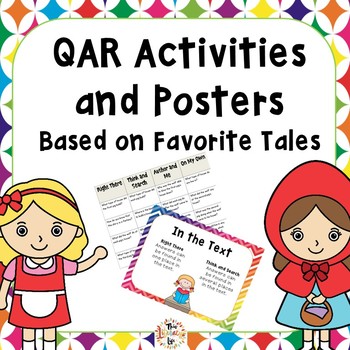
For example, The Three Little Pigs is a familiar story to many students. I use this one a lot to help older students simply understand something like cause and effect or theme. I really like using it to help introduce QAR (Question-Answer Relationship) to students. I created a QAR sort using this story to help students with this skill. Click below to head to my TPT store to purchase it. I hope to add some more fairy tales to this over the summer, if time will allow me.
I love that fairy tales are such simple stories. They are perfect for teaching plot structure, even to older students. Since the stories are familiar (sometimes), they can really hone in on those parts of the plot. Here is an example of how a group of 6th graders used Little Red Riding Hood to show plot structure.

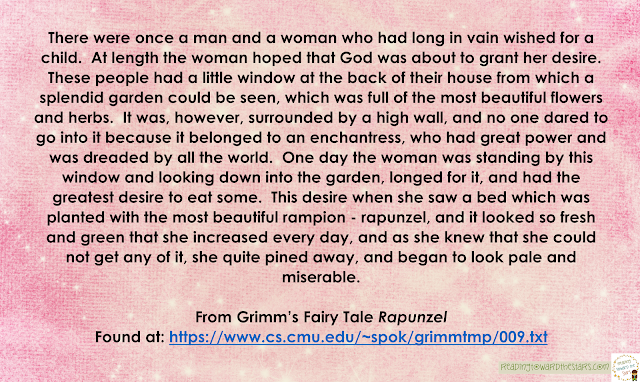
The rich vocabulary in the tales also allows for great context clues and vocabulary instruction. Kids can get so much out of those tales. Reading this excerpt alone from Rapunzel, you can see all of the great vocabulary students can learn.
A few years ago, I worked with my students to see the differences between Goldilocks and the Three Bears and The Three Snow Bears by Jan Brett. Here is what we did to see the differences.
So, use those fairy tales in every grade level! Our students can learn so much from them!
Share it with the world and pin for later!


0

When teaching a new comprehension skill, many times I use fairy tales since they are a familiar story to many children. We don't have to take the time to think about the plot of the story and can focus on that skill.
For example, The Three Little Pigs is a familiar story to many students. I use this one a lot to help older students simply understand something like cause and effect or theme. I really like using it to help introduce QAR (Question-Answer Relationship) to students. I created a QAR sort using this story to help students with this skill. Click below to head to my TPT store to purchase it. I hope to add some more fairy tales to this over the summer, if time will allow me.
I love that fairy tales are such simple stories. They are perfect for teaching plot structure, even to older students. Since the stories are familiar (sometimes), they can really hone in on those parts of the plot. Here is an example of how a group of 6th graders used Little Red Riding Hood to show plot structure.

The rich vocabulary in the tales also allows for great context clues and vocabulary instruction. Kids can get so much out of those tales. Reading this excerpt alone from Rapunzel, you can see all of the great vocabulary students can learn.

And let's not forget comparing and contrasting. Not only can students compare and contrast characters within the fairy tales, but they can compare characters between tales or even types of tales. I spent that summer in graduate school looking at some different versions of Cinderella, and now there are so many others for different tales. I love seeing how different cultures change the tales up a little to meet their needs. Recently, I purchased Petite Rouge by Mike Artell, which is a Cajun version of Little Red Riding Hood. I love reading those with students and then comparing and contrasting the two books ~ characters and all!
A few years ago, I worked with my students to see the differences between Goldilocks and the Three Bears and The Three Snow Bears by Jan Brett. Here is what we did to see the differences.
 |
| Click {here} to see that blog post! |
So, use those fairy tales in every grade level! Our students can learn so much from them!
Share it with the world and pin for later!



 tells the story of Clifford the puppy as he goes to school with Emily Elizabeth. Of course, he gets into some trouble, but the class always finds a way to make Clifford have an awesome day.
 clean everything up but continues to make an even bigger mess. The children also help him get everything back in order.