This Literacy Life: mentor text

Showing posts with label mentor text. Show all posts

Summarizing History with a Different Viewpoint

History has a way of repeating itself, but many times in different ways. In light of what our world has seen in the past few months, the book Let the Children March by Monica Clark-Robinson allows us to see how history handled situations that shaped our world today.
Helping readers summarize and see different perspectives is simple with the book Let the Children March.


I have partnered with my Reading Crew friends to showcase diverse texts and how we can use them in the classroom to enhance instruction. Keep reading to see how I used Let the Children March to enhance history and writing lessons.
**Affiliate links are scattered in this post. That means when you click and make a purchase, I make a small percentage back at no cost to you.**
0

Easy Ways to Teach Perspective with Mentor Texts

Mentor texts are great for helping our students better understand reading and writing. I use mentor texts quite a bit to teach my students new comprehension skills, and teaching perspective has several great texts to help children see how this important skill works in every day life. Virginia Readers' Choice picture book Alfie: (The Turtle That Disappeared) is the perfect book for helping students see that there are two sides to every story.
Different perspectives make stories more interesting and help readers see the entire story. Alfie: (The Turtle That Disappeared) is the perfect mentor text for seeing both sides of the story.

{Affiliate links are present in this post. This means when you click and purchase on a link, I make a small amount of money at no cost to you.}
0

Building Letter Writers with Mentor Texts


The other day my daughter wanted to write a letter to her favorite You Tuber. I jumped on the chance to engage her in what was one of my favorite things to do as a child. We worked together to write a perfect letter, at least for a second grader.
Make teaching letter writing with your students fun with this fun mentor text. The ideas this book and unit give you and your students will make any lesson fun!

Flashback to my past. I wrote my cousin a letter every single month. She lived 6 hours away, and I only saw her 3 times a year, if I was lucky. We kept in touch via letters and loved it. Writing letters for different reasons helps children better understand what the world around them has to offer. Using books to help students better understand letter writing is a great way to get them motivated to write the perfect letter.

My friends from The Reading Crew and I have a link up full writing mentor lessons, freebies and prizes you don't want to miss!

Affiliate links may be present in this post. This means when you click and purchase, I get a small amount of money at no cost to you.

3

Teaching Problem Solving Skills with Goggles

Problem solving is an important life skill, and Goggles by Ezra Jack Keats is a wonderful book to help with it. Stop by for a freebie to go with the book!

It's everywhere. We all have them...problems! And we have to find a way to solve them, even if there is more than one way. I have joined in with my friends at The Reading Crew to bring you another fun mentor text blog series to get you ready for school! {Affiliate links are scattered throughout the post to fund future book purchases.}

3

Fact vs. Opinion with Penguin Problems

Fact and opinion can be tough, but these penguins sure do make it fun! The mentor text Penguin Problems helps students learn about penguins in a fun way too!


We all have plenty of problems in the world. It seems that even simple things can make things difficult for us. But what about penguins? They have problems too, and the book Penguin Problems by Jory John and Lane Smith will show students much about penguins while getting a little laugh too. I have joined with my friends from the The Reading Crew to share some of our favorite winter mentor texts with you.  {Affiliate links provided to fund future book purchases.} Read more to get your lesson, freebie, and enter the giveaway (look for my mystery word in blue in the post).

11

Too Many Pumpkins: A Mentor Text for Problem and Solution

Using mentor texts helps our students understand important literacy concepts. Too Many Pumpkins is a fun book to help students with problem and solution.

It's that time of year again: pumpkins, apples, and mentor texts! Yes, The Reading Crew is back at it again with their fall mentor text link up, and I am sharing one of my favorite fall books with a fun, free, and easy lesson to go with it! Find out how you can use Too Many Pumpkins with your students to help them have a better handle on problem and solution. {Affiliate links provided to help fund book purchases.)

5

One Day, The End: Adding Details on Book Talk Thursday

Adding details to stories can be a struggle for many students, but the book One Day, The End can help students see the importance of adding details and change writing forever!

Writing can be tough for many students. As a teacher, it is one of the hardest things to teach. Students are all at different places with writing, and the different styles make it harder for students and teachers. When students are finally able to get their ideas on paper, they really struggle with the details. The book One Day, The End is a perfect mentor text for helping students realize that adding details is so important! (Affiliate links provided to fund book purchases.)


0

Flip Flops, Beach Chairs, and Teaching With Mentor Texts Summer Blog Hop

Read alouds make a perfect way to enhance classroom instruction!  Keeping students interested and engaged can be tricky sometimes. DLTA is a great way to make sure they are involved in the reading!

Summer is here, and I am excited to team up with some of my friends to bring you a mentor text blog hop like no other! All of the blogs participating have a book to share, lesson ideas, and a freebie (some forever and some limited time). So hop around and enjoy!
6

Growing Readers and Writers by Teaching with Mentor Texts

I am so excited to join my friends at The Reading Crew for another fun Mentor Text Linky Hop. 25 of us have gotten together to bring you many different books and lessons to enhance literacy instruction.


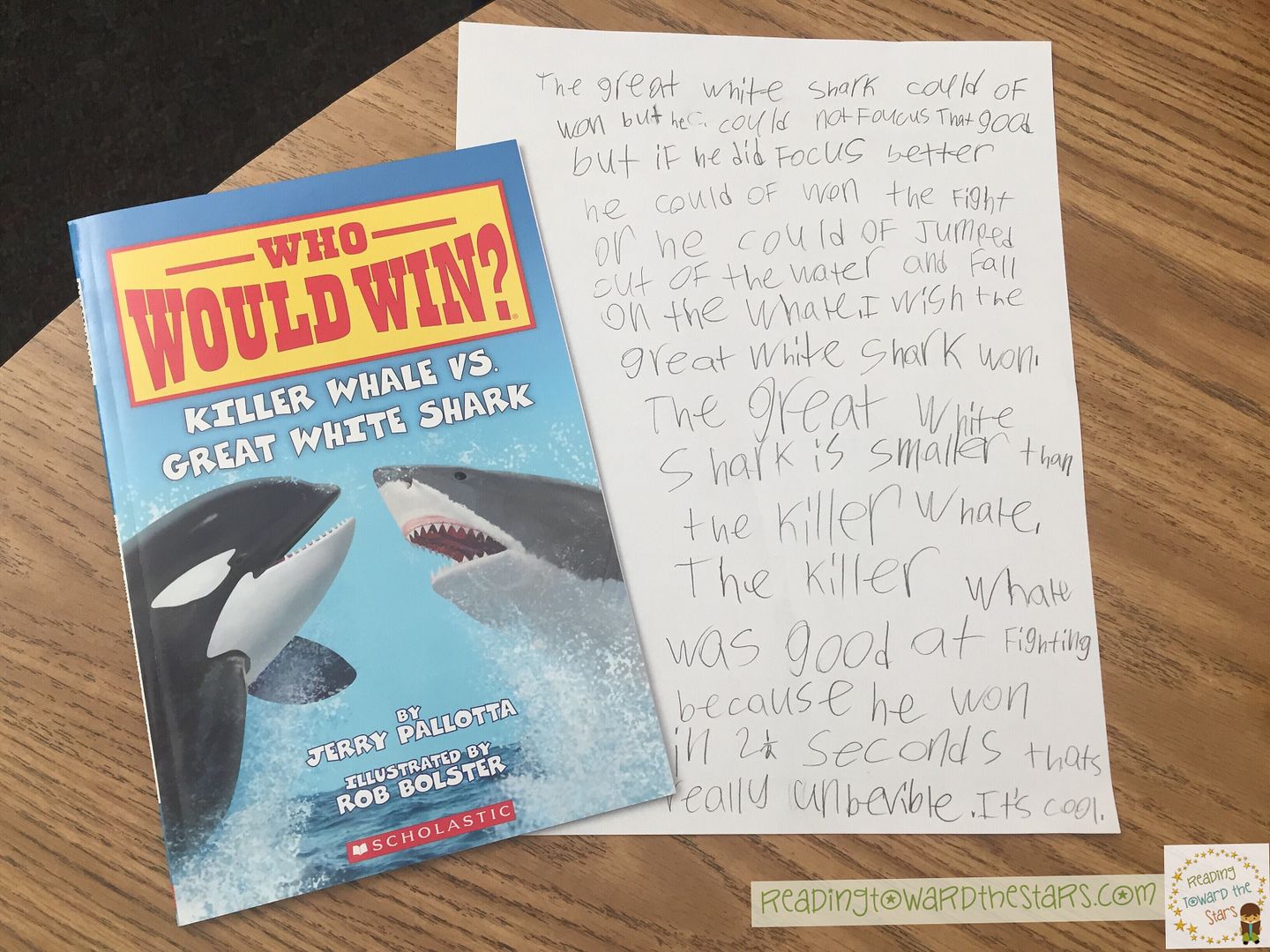
This time of year many different animals are all around, and children LOVE to read and learn about different animals. A few months ago, Scholastic had a set of Who Would Win books, and I knew my students would not be able to put them down.


I chose these books to use for several different reasons. My biggest reason was engagement. Kids love these books, and I wish you could have all seen how their faces lit up when I took them out.  They loved that they could choose their own books too. The books include facts about two different animals or insects that are similar in some ways yet different in others. The book compares and contrasts them beautifully with many pictures and text features. At the end, Pallotta pits the two animals against each other and tells who he thinks would win and how.  How fun!


We spent some time talking about comparing and contrasting regular items and pictures. I then allowed the students to choose a book from my selection to read. They read the book, all the while discussing their own books. I let the conversations roll because I knew the reading was authentic!

After reading the book, each student filled out the chart, showing how the two creatures were alike and different. Each opposite square had to match {has a stinger---uses teeth}. This was a challenge, but they finally caught on after a few attempts.


The best part about these books is that the other creature could win. In my pack is a page where students can focus on certain parts of the creatures to write how the other creature would win. Here are some examples of my students' work.


Students could also research two different animals and write their own "Who Would Win" type of essay.

You can grab my Who Would Win activities by clicking here or on the picture below:


3

Mentor Monday ~ 3/31/14: Visualizing

Tomorrow is the first day of April and the beginning of Poetry Month.  Poetry is perfect for visualizing, and I am linking up with my friend Emily from The Reading Tutor/OG for Mentor Monday.  This week is all about visualizing.
http://thereadingtutorog.blogspot.com/2014/03/mentor-monday-linky-33114-visualizing.html
I have been looking high and low for new poetry books and stumbled upon the book Poem-mobiles: Crazy Car Poems by J. Patrick Lewis and Douglas Florian.
The book is full of great poems that describe various different crazy cars.  The pictures that accompany the poems are full of vibrant colors and lots of fun ~ perfect to help students with visualization.

One of my favorite poems is "The Dragonwagon".  With lines like

Upon its back are nasty spikes

and

Instead of wheels, it has sharp claws
That hug the road and sharply turn.

students are sure to paint a fun picture of the Dragonwagon.

Another personal favorite of mine is "High-Heel Car".  The girls will especially have fun as they draw pictures of a giant high heel car. 

I plan to use these poems with my second graders over the course of the next week.  I am going to read the poems to the students.  After they listen to the poems, they are going to draw a picture of the car that is described in the poem.  Once they have drawn the pictures, they will also describe the car in their own words.  If time allows, I will even have them write a poem about their own imaginary car.

I can't wait to see what they do!  I will have to post pictures when they do!

What are some fun poetry books you use for helping students with visualizing?
2

Mentor Monday Linky: Analyzing Characters ~ 3/10/14

I was so excited to find out that the topic for this week for Mentor Monday at The Reading Tutor/OG was character analysis.  I have spent a lot of time in the past working on this with many of my groups.
http://thereadingtutorog.blogspot.com/2014/03/mentor-monday-linky-31014-analyzing.html

Congratulations, Emily, on the birth of your little baby girl!  She is a cutie!  And thanks, Wendy from Read with Me ABC for hosting as a guest blogger this week.  I am so glad to be able to keep it going!

I want to share a mentor text and idea for character analysis this week.  It is one of my favorite books to use for it.  Many of the kids can relate to the characters in the story.  I love using Julius, the Baby of the World by Kevin Henkes.
In the book, Lilly is faced with the challenge of the arrival of her new baby brother,Julius.  He gets all of the attention, and she is not happy.  She resorts to calling him names and making fun of him, even to the point of saying mean things to him in his crib.  Jealousy plays a huge role in her feelings, just as they do with many children in the same situation.  But when her cousin insults Julius, Lilly stands up for him since he can't stand up for himself.  What a true change of character and a show of love!

This book is perfect for looking into a character's heart and thinking about the changes that Lilly makes because of her little brother.  Students can map out how Lilly's feelings change through the story by focusing on the the turning point in the story.

To help my students better comprehend the text, I use a character change chart.  Just as in real life, the students can see that Lilly has a change of heart because she really does love her brother.  Love wins over jealousy in this case!  Click {here} or on the picture below to grab your copy of the character change chart which can be used with any book. 
https://www.dropbox.com/s/z2irda25ld9gzg0/character%20change.pdf

What books do you use to help students understand character analysis?  Leave a comment below or link up with The Reading Tutor/OG with your book!

Classroom Freebies Manic Monday
4

Mentor Monday 2/10/14: Nonfiction Text Structures

I love linking up with Emily, The Reading Tutor, OG for her Mentor Monday and am super excited this week because it is exactly what I am working on with my fourth graders this week!
http://thereadingtutorog.blogspot.com/2014/02/mentor-monday-linky-21014-non-fiction.html

This week, we are working on nonfiction text structures.  We spent a couple of weeks working on nonfiction text features (captions, index, headings, etc.), but text structures are different.  They help the students understand what they are reading by thinking about how the author has set up the text.  This is super beneficial to students as they will see more of this in real life reading.  Think about magazines and newspapers.  They have some text features in them but not all of them. 

Teaching text features is still important because we use them when we read books and textbooks, but the text structures help the students comprehend WHAT they are reading.

I was looking for some information and came across this great post at Reading.Writing.Thinking.Sharing that helped me have a better understanding of where to start.  Then I came across this wonderful website by Mrs. Judy Araujo that helped me have an even better understanding of what and how to teach them.  The best part about these is that they are much like the Thinking Maps we are required to use in our district.  The descriptions of the features and the organizers fall in line with the ideas of Thinking Maps.  This makes my job 100 times easier!

So, this week I am starting with the nonfiction text structure of description.  To scaffold instruction for the students, I have chosen a nonfiction text about weather, which is what they are studying in science right now.  Our library didn't have what I wanted, and I didn't have time to order something, so I searched one of my new favorite sites where we can read many books for free:   We Give Books!  I picked out the book DK Eye Wonder Weather.

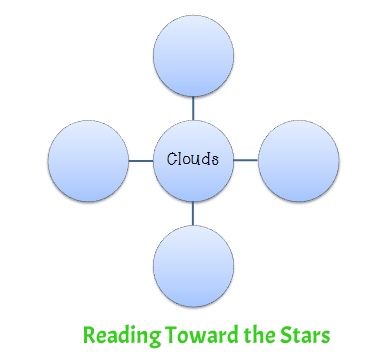
I won't use the entire book because two 30 minute sessions won't get it all in if I do, but I will use a portion of the book to show them how the author uses description to tell about the clouds.

http://www.wegivebooks.org/books/weather/reader
We will read through this part together from my computer.  {Wish I could use it on iPad, but it is not supported.}  Then we will use the graphic organizer {Thinking Map} for description to tell about what we learned.   This will become our anchor chart for description as a nonfiction text structure.  We will also look for various signal words that help find the descriptions.
After we work with the graphic organizer to describe the clouds, the students will work in pairs to look in books about weather and for us to discuss.  The students will work together to make the graphic organizer {Thinking Map} about their topic in the books and share them with the group.  To end our lesson on the nonfiction text structure of description, the students will read a passage and create their own Thinking Map {graphic organizer} for the topic and then answer some questions about it.

There are so many great books to help students with the nonfiction text structure of description, but I can't list them all!  What are some other great books we can use to help students understand the text structure of description?

5

Mentor Text Monday: Inferences

I know, I know!  It is Tuesday, and I really should be doing this on Monday, but I am a day late.  But, better late than never, right?!  I am linking up with my friend Emily from The Reading Tutor/OG for Mentor Monday.
http://thereadingtutorog.blogspot.com/2014/02/mentor-monday-linky-2314-making.html
I was so excited when she said that she was going to be focusing on making inferences this week because it is one of my FAVORITE skills to teach!  Most people dread it, but I LOVE it!  I love to make my students think beyond the literal and "read between the lines".

One of the texts I love to use when beginning any unit on making inferences is a favorite picture book:  Tuesday by David Wiesner.
The students have to look at the pictures in the book to figure out what is going on.  Using wordless picture books to help students make inferences is a perfect way to introduce the concept, even to the youngest readers.  In the book Tuesday, frogs fly around on lily pads throughout the city.  Students have to think about what is happening in the book.  It is always fun to listen to the ideas the students have for what is happening in the book.

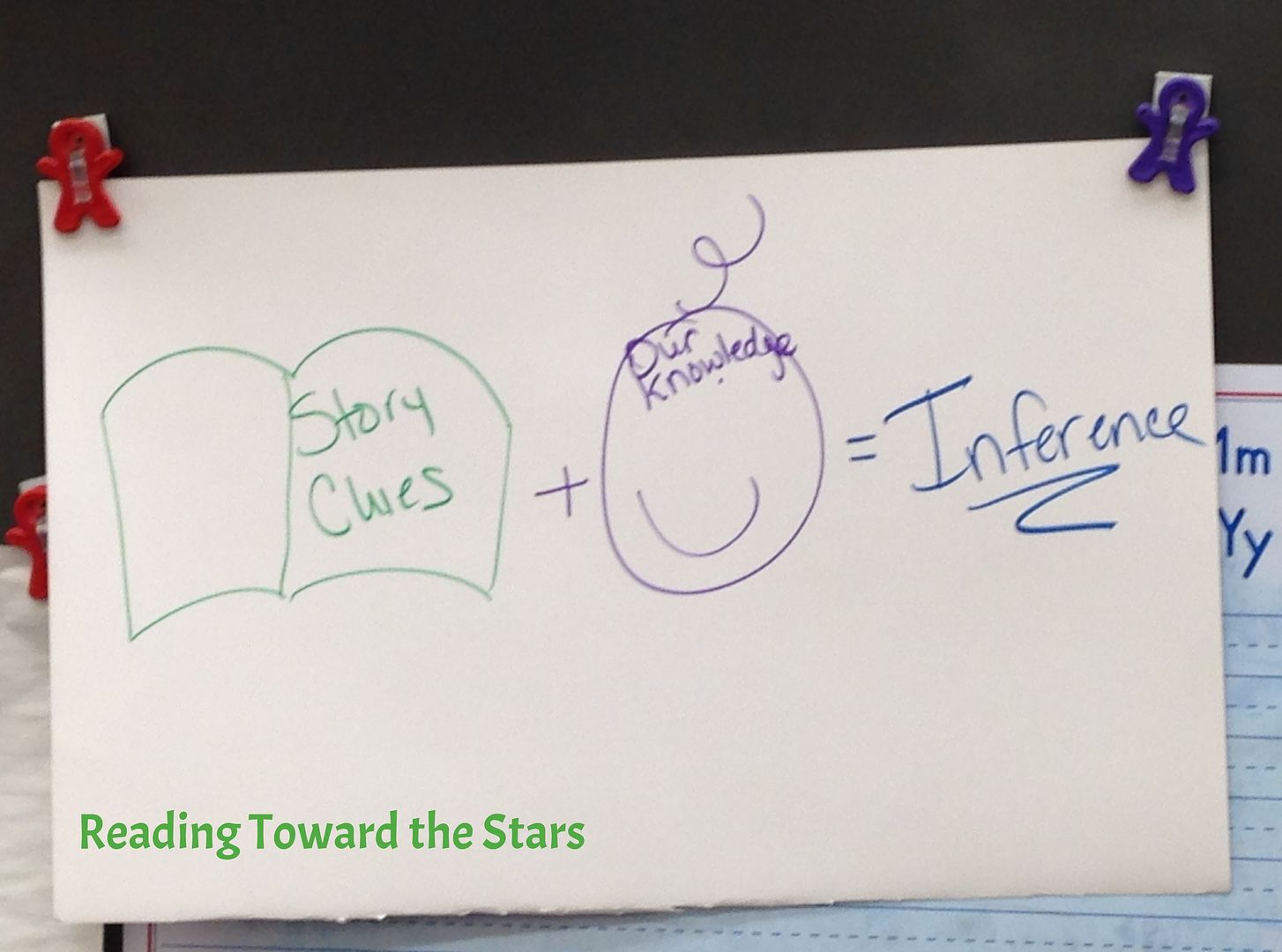
We then talk about what they did to make those inferences and create a simple chart to help them remember what it takes to make inferences.  This is an example of a super simple one, but as the students go up in grades, we add to them.
This book is perfect to use with any grade level because even emergent readers can "read" the pictures and tell the story.

Another great picture book series that is perfect for younger students are the Carl the dog books.  My son "read" these to me when he was really young.  These were the first books he read, and he loved that he could "read" them.  He was always spot on with the stories and really focused on the feelings, something that a some books don't tell the reader.  Kids will enjoy this fun Carl book at this time of the year.  There are a few words, but the main story is crafted by the reader.  How cool is that?!
What books do you use to help students make inferences? 

3